|
Pink Families |
|
|
Introduction
"History with its flickering lamp stumbles along the trail of the past
trying to reconstruct its scenes, to revive its echos
and kindle with pale gleams the passion of former days".
The recorded past is available for us to discover. We can define our personal heritage at almost any time it is convenient for us to do so. The recent past and the present are not as easy to discover.
Have you ever wondered why your grandmother and grandfather so treasured a faded photograph, a worn bible, that small garden patch in their back yard? Have you ever wondered why the family holidays for your mother's family are different from those occasions spent with your farther's family? Remembering and preserving these memories, customs and traditions all establish a family heritage. Many families have already done the research necessary to preserve their family story. Many families have not. Many do not know how to begin because their family has been so geographically separated or because it is too late to discover their recent past.
These web pages are written to help the individual identify and communicate with living members of their family. The contained here can only be a starting point for you, the reader. It is a general look at the Pink name, the people who share it, and how you can go about expanding your knowledge of family history and individual lineage or family genealogy.
Your unique family heritage is what genealogists call "clues to your past". Properly collected and pieced together, these clues unlock the most exciting adventure you will ever experience. These clues learned from other members of your family teach you the story of your origin! Your meeting with a reputable professional genealogist to fully explore the possibilities and to gain the full satisfaction in tracing your own family lineage is suggested. Procedures for this search are included so that you can embark on a new and exciting adventure of discovery of your own roots.
Unless we have been especially wise and especially fortunate, many of our ancestors will have left us before we have gleaned their knowledge of our family's past. And worse, perhaps, they may have left us with few clues as to their origins.
Who were those people who gave me my family name? Perhaps even my baptismal and confirmation names? Where did they come from? In what parts of England did they settle? How long did they stay? Where did they go, those who left for other lands? What were they like when they were here? Why did they leave their homeland?
For most of us, the questioning ends here; we never get beyond the level of idle curiosity. Not because we are not interested -- what is more fascinating than to trace one's origins? But where does one begin to look? What documents should one seek? What spelling changes might have occurred in the name since its origin, brought on by time, by migration, by ignorance, even by political expediency? In fact, such tracing almost always involves considerable amounts of time, often a considerable amount of money, and some special skills.
And so, because few of us have the time or the money or the special skills needed to follow through, we put it off "until later". And so our good intensions often fail to bear fruit -- fruit, in this case, which would be of interest not only to us, but to our own descendants. It would also be of interest to many others of the same or a related surname elsewhere in the world. Our effort might be the inspiration for their searches. But the longer we put it off, the more difficult the tracing becomes.
Which is why, when an opportunity comes along to have experts do some tracing for us, and do it at a truly modest cost, we are usually glad to take advantage of the offer.
As you read on, allow your memory to recall and associate anything you may ever had heard a relative say -- even most apparently offhand fragment of information may be found later to fit into the puzzle of reconstructed origins. For our origins are all shrouded in mystery beyond a certain point.
In order to understand both the origins of and any changes which may have occurred in our family name, we must remember that an individual family is always part of a larger group -- a tribe, a clan, a people. Except for certain very outstanding individuals, the most likely place to start our search is in the histories of tribes and peoples.
The British People: Their origins and destinations
Origins
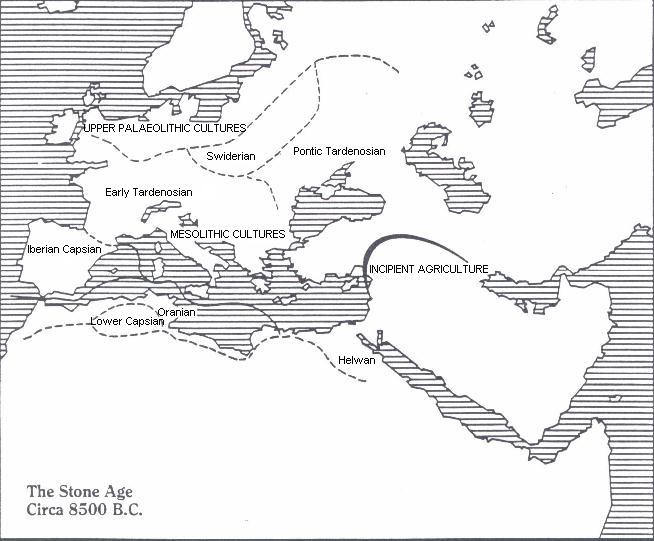
Back in the stone age, some eight or nine thousand years before the modern era, Britain was still a promontory on the western coast of Europe, part of what is now northern France and the Netherlands. There was the English Channel; it was then dry land. The Strait of Dover was perhaps a tidal race into which flowed both the Thames and the Rhine before the combined stream emptied into the North Sea. Thus it was that when a series of geological cataclysms struck the area in about the eighth millenium before the modern era, the Bronze Age had not yet supplanted the Stone Age in western Europe. And when the upheavals had lowered the plain that is now the floor of the channel and raising the chalk cliffs of Dover, the people on this side of the divide -- the "Pretons" of "Albion" and "Ierne" as aristotle would describe them in the fifth century B.C. -- were left in rather primitive isolation. This also suggests that the earliest inhabitants of this island were probably not distinguishable from the inhabitants of western Europe. They brought their ancient forms of Gaelic still spoken in parts of Ireland and Scotland and the Brythonic of Wales, Cornwall, and Breton. Religious practices were almost certainly Druidic -- a somewhat melancholic religion about which we know very little with any reasonable certainty, but which clearly did offer human blood periodically to appease the gods.
Over succeeding centuries, in part perhaps out of fear of further cataclysms, perhaps in part to find more defensible refuges from the coastal forays of the Norsemen and Danes, as well raids by others from their own ethnic stock, these earliest Britons appear to have moved or to have been driven gradually toward the higher ground in the west and north of the newly formed island.
About this period we can still do little more than speculate. Hard evidence is very scarce, and what does exist is still the subject of considerable disagreement among experts. It is not impossible that some family names still survive from this epoch, but it would be impossible to trace one reliably. There is more to work with when we consider the present epoch in English history: A considerable number of existing English, Irish, and Scottish surnames must have originated in the early historical period. We know this certainly with respect to a considerable body of placenames, a few even antedating the Roman period.
Unlike the history of people, the history of names began with literate societies. Unfortunately, the pre-Roman peoples of Britain did not have a written language. However, all of this began to change when the Romans arrived on the shores of Britain. The Romans kept meticulous records which gave us our first historical account of the island they called Brittania.
European Emigration to the United Kingdon
The Roman Period
When Julius Caesar invaded in 54 B.C., he embarked from the continent at Boulogne. This area was settled by Belgic tribes, such as the Britanni who lived just south of Boulogne. Caesar knew that Belgic invaders had already settled in Britain and assumed that they were from the Britanni tribe. Ever since Caesar made his assumption, the country has been known as the land of the Britons, or Britannia. This is a wonderful example of how people, or places get names by mistake. In actual fact, the Belgic tribes which arrived in Britain were not even from this district and were certainly not from the Britanni tribe.
In 54 or 55 B.C. Julius Caesar executed a short and not particularly successful foray onto the plains along the southerly side of the Thames. Already planning his triumphant return to Rome, he may have wanted simply to add another trophy to his record; or he may have wondered whether he could cut off a retreat for some particularly troublesome Gallic tribes. But the Channel proved more fearsome than the naked native warriors, clean-shaven and painted all over in an intimidating blue. Channel storms destroyed much of his fleet, and he was fortunate to regain the continent relatively unscathed. Caesar's visits did little to disurb the local islanders and the bulk of the population remained Celtic.
Not again until 43 A.D., under the Emperor Claudius, would Romans set a conquering foot on the island and by about 75 A.D. they occupied Britain from Plymouth and Humber. Claudius arrived with an army of about 40,000 troops. The army gradually conquered the British tribes and brought Roman citizens to settle in Britain. These early Roman immigrants arrived from areas spanning the Roman Empire and included Gallic troops and Spaniards, Germans and Burgundians, specialised slingers from the Balearic islands and archers from Crete and the Middle East. Such a huge machine was the product of a highly centralised system of government and could only be maintained by a large civil service.
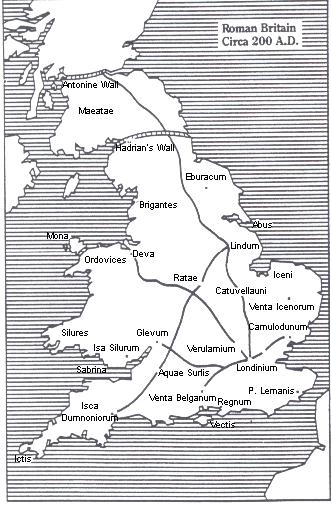
During the four centuries of Roman rule men came from many parts of the Roman world to serve as officials in the administration. Some of these people left Britain at the end of their term of duty, but some stayed and settled. Estimates suggest that the population of Roman Britain around A.D. 200 was between 4 and 6 million, much the same as England at the end of the middle ages and about twice the size it was at the time of the Domesday Book in 1066.
|
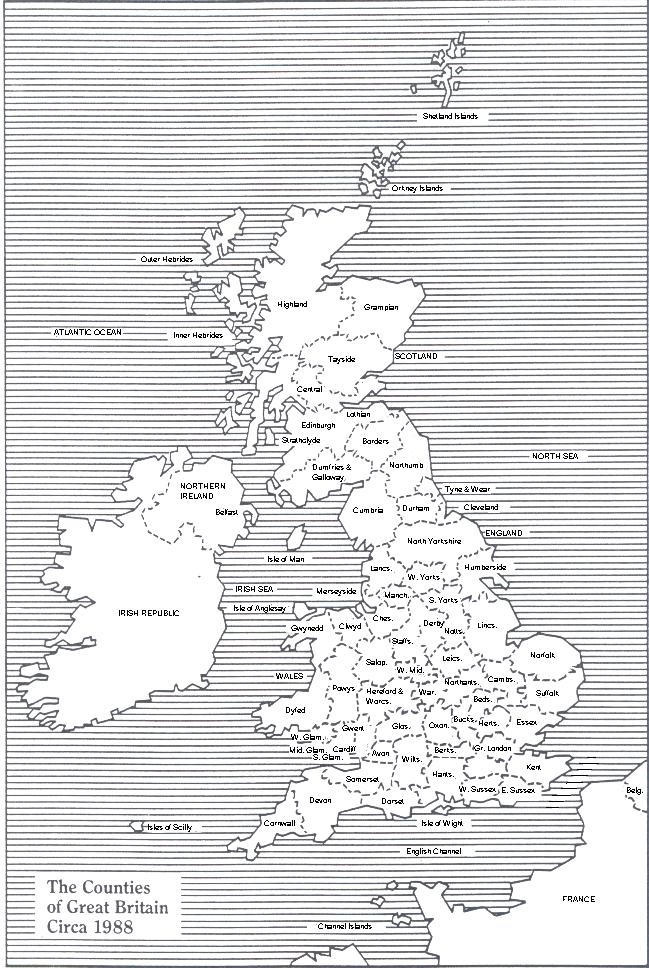
Three cities were founded specifically to provide for army encampments; Colchester, Lincoln and Gloucester. Any site containing chester, caster, or cester on our map marks the site of a Roman, or Romanized settlement: Gloucester, Winchester, Brancaster, Chester (Cheshire). The Romans were responsible for building Hadrians Wall across the island's waist from the Solway Firth on the west coast to the mouth of the river Tyne in the east, and the city wall of London. Four great military roads radiated from Londinium to the north, northwest, west and southwest. A fifth connected what is now Lincoln to the Sabrina - the Severn. These roads linked cities and towns in a great communications and trading network. As the roads were built, the Roman army moved throughout the lowland zone of Britain and into the highlands, leaving garrisons en route. A halt was called in the northern Highlands and Hadrians Wall was built. It was great civil engineering and architectural works such as these which remained as witnesses of the past when the Roman Empire in Britain declined and faded away. |
Long after the Roman money economy and mass production industries, such as pottery manufacture disappeared, Roman buildings stood, even if in ruins. The underfloor channels of the central-heating systems of the luxury country villas remained as evidence of a past civilisation long after they had ceased to give warmth to chilly Romans in our northern winters or even to dry corn in the days of decline and collapse of Roman Britain. The Roman Wall of York stood throughout the Middle Ages and still stands today.
Very often it is survivals such as these which have found their way into place names. Although surnames were not used at this time, the origins of some surnames may date back to place names from the Roman period. The origins of some surnames may even date back to early place names used by the Celts. This is especially true where the names of natural features like great rivers, hills and forests are concerned. Even the Celtic name of London has survived, but in Roman form.
The Roman Empire in Britain collapsed gradually and unevenly. By 410 A.D., the Romans, preoccupied with barbarian attacks much closer to home, withdrew their military contingents and left the local inhabitants prey to marauding invaders.

Meanwhile in the late third though fifth centuries, another influence had come to bear on the island: the early Christian missionaries -- even perhaps, the great Augustine himself. And no Irishman, surely, needs to be reminded of St. Patrick's return to the island in 432. Although the Christian elements in the island would lapse into long and bitter eclipse after the departure of the Romans, the remote monasteries especially became the repositories of whatever English history was to survive though the long night ahead.
The Anglo-Saxon Epoch
The year 449 is usually given as the starting point of Anglo-Saxon epoch, although the designantion is less than completely accurate. This period was marked by lingering decline and decay mixed with occasional prosperity. The local inhabitants were finally relieved of paying Roman taxes, but had no army to protect them.
According to the Venerable Bede, a monk at the Northumbrian monastry at Jarrow, about this year began the great series of Teutonic invasions. These invaders ultimately gave this land both its common language and its names - and possibly your name as well. Like the rest of the Roman Empire across the Channel, Britain was threatened by barbarian attacks. The arrival and settlement of the barbarians meant more new and different people in the population. They radically affected the way of life and the names of the inhabitants of Britain.
Who were these people? The earliest attackers appear to have been the Picts and the Scots. The Picts, who inhabited Scotland invaded in a southerly direction. The Scots, confusingly for us today, were actually from Ireland and attacked from the western coast. The Picts were successfully resisted by the Romano-British and never established themselves across the border. The Scots penetrated into West Wales and Western Scotland where they formed settlements.
The Venerable Bede (c. 673-735) was a famous Northumbrian historian and the first to use the name England. It is commonly known from his writings that England was settled by the Angles, the Saxons and the Jutes. According to Bede these three races all came from Northern Germany and the Danish Peninsula.
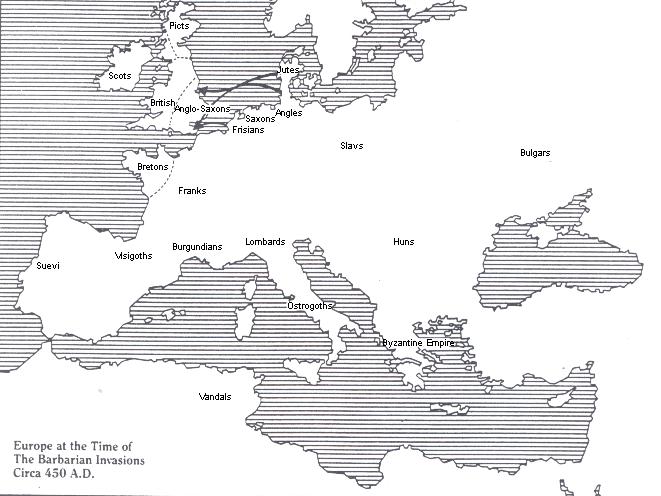
The Jutes and Angles arrived from the Danish peninsula and the Saxons and other Germanic tribes emmigrated from the lowlands around the mouth of the Rhine. Details are scarce: We do not know who crossed first or precisely where they landed, nor how much resistance they encountered. Bede does mention that the Jutes settled mostly in Kent and the Isle of Wight.
Bede referred to shiploads of Germanic soldiers who crossed the Channel, possibly in great open rowing boats, when he writes of the "Arrival of the Saxon". Although precise dates of these journeys are impossible to substatiate, Bede knew that they occurred in the middle of the 5th century. In fact, archaeology shows us that there were Germanic troops in Britain well before 410, helping with the defense in Late Norman Britain, as they did on the Roman borders and the Continent. When the Roman army had departed, the Romano-British people hired barbarian German mercenaries to protect their villages from invasion. It seems that what followed was a long struggle for power between the newcomers and the local rulers.
The ultimate victory of the Anglo-Saxons led to great changes as they came from Southern Scandinavian and Northern Germanic cultures. These areas were hardly touched by Roman civilisation. It is interesting for the reader to note (see Norman Conquest) that France was settled by tribes who were much more Romanized. The Anglo-Saxons were capable of exquisite craftmanship, yet lived in very rudimentary houses quite different from the luxurious Roman style villas with their primitive central heating ducts. The Anglo-Saxons moved away from the towns to more agrarian type settlements. These settlements came to be ruled by a new social organisation which was dominated by powerful and widespread families, by lordship and eventually by kings. This new social organisation marked the beginnings of feudalism.
Racial mix was more complicated than the names of kingdoms suggest. However, the Angles came to dominate in East Anglia, in the Midland kingdom of the Mercians, and in Northumbria. The Saxons advanced from the east: the East Saxons; and, from the south: the South Saxons and the West Saxons. Several English district names commemorate this era: Sussex, the more southerly Saxon settlements; Essex, the more easterly; Middlesex; and Wessex, the more westerly settlements.
The Celtic people survived among the new settlers most often as slaves. However, they also formed kingdoms in the highlands of Wales and Scotland and the far Southwest. They even formed the kingdon of Elmet in the area of the West Riding of Yorkshire in Northumbria which survived until the 7th century. The Celtic language split into two groups: that spoken by the Welsh, Cornish and Bretons (there was emigration from Western Britain to Brittany in the 5th and 6th Centuries), called Brythonic, and that spoken in Scotland and Irelend (Gaelic) and the Isle of Man, called Goidelic. The Celtic people too had changed in the post-Roman period and this helped to emphasize the historical differences between the Roman and post-Roman periods.
These differences narrowed as a result of the work of Christian missionaries starting in the later 6th century. Christianity had first become strong in Britain in the 4th Century. Although it had survived in the west and north after the Roman period, it seems to have disappeared from the areas conquered by the pagan Anglo-Saxons. They brought with them Germanic gods, just as the Romans had introduced different Gods from those worshipped by early Britons.
The work on conversion to Christianity began with the mission of St. Columba from Ireland to Iona, an island off the Scottish coast, where he founded a monastery. In the year that St. Columba died (597), Catholic missionaries began arriving in Kent. They were dispatched by Pope Gregory the Great from the city of Rome and led by Augustine. The effect of this two-pronged, Celtic and Roman, attack on paganism was the conversion of the kings and courts of the various Anglo-Saxon kingdoms by the 660's.
Much more slowly followed the conversion of the people and the rebirth of literacy. In the history of names this had an important effect in the long-term, especially after the Norman conquest when more and more children were given names from the Bible, from both Old and New Testaments. But in the shorter term we see the Anglo-Saxons keeping their pagan names.
| RULERS OF ENGLAND AND GREAT BRITAIN | |||||
| ENGLAND |
BEGAN TO REIGN |
YEARS OF REIGN |
GREAT BRITAIN |
BEGAN TO REIGN |
YEARS OF REIGN |
|
ANGLO-SAXON LINE Egbert...King of Wessex Ethelwulf...Son, King of Wessex Ethelbald...Son of Ethelwulf Ethelbert...2nd Son Ethelwulf Ethelred I...3rd Son of Ethelwulf Alfred (The Great)...4th Son of Ethelwulf Edward (The Elder)...Son of Alfred Athelstan (The Glorious)...Son of Edward Edmund I...3rd Son of Edward Edred...4th Son of Edward Edwy (The Fair)...eldest Son of Edmund Edgar (The Peaceful)...2nd Son of Edmund Edward (The Martyr)...eldest Son of Edgar Ethelred II (The Unready)...2nd Son of Edgar Edmund II (Ironside)...Son of Ethelred II DANISH LINE Canute (The Dane) Harold I (Harefoot)...Son of Canute Hardecanute...Son of Canute SAXON LINE Edward III (The Confessor)...Son of Ethelred II Harold II...Brother in Law of Edward NORMAN LINE William I (The Conqueror)...defeated Harold at Hastings William II (Rufus)...3rd Son of William I Henry I (Beauclerc)...youngest Son of William I HOUSE OF BLOIS Stephen...Son of Adela, daughter of William I PLANTAGENET LINE Henry II...Son of Matilda, daughter of Henry I Richard I (The Lion-hearted)...Son of Henry II John...Son of Henry II Henry III...Son of John Edward I...Son of Henry III Edward II...Son of Edward I Edward III...Sone of Edward II Richard II...Grandson of Edward III HOUSE OF LANCASTER Henry IV...Grandson of Edward III Henry V...Son of Henry IV Henry VI...Son of Henry V HOUSE OF YORK Edward IV...Great-great grandson of Edward III Edward V...Son of Edward IV, murdered in Tower of London Richard III...Brother of Edward IV HOUSE OF TUDOR Henry VII...Son of Earl of Richmond Henry VIII...Son of Henry VII Edward VI...Son of Henry VIII Mary I...Daughter of Henry VIII Elizabeth I...Daughter of Henry VIII |
829 839 858 860 866 871 899 924 940 946 955 959 975 978 1016 1016 1035 1040 1042 1066 1066 1087 1100 1135 1154 1189 1199 1216 1272 1307 1327 1377 1399 1413 1422 1461 1483 1483 1485 1509 1547 1553 1558 |
10 19 2 6 5 28 25 16 6 9 3 17 4 37 0 19 5 2 24 0 21 13 35 19 35 10 17 56 35 20 50 22 13 9 39 22 0 2 24 38 6 5 45 |
STUART LINE James I (James VI of Scotland)... Son of Mary Queen of Scots Charles I...Only surviving son of James I, beheaded 1649 COMMONWEALTH (1649-1660 Oliver Cromwell...Lord Protector Richard Cromwell...Son of Oliver Cromwell STUART LINE (RESTORED) Charles II...Eldest Son of Charles I James II...2nd Son of Charles I HOUSE of ORANGE William III and Mary II...Son of daughter of Charles I and eldest daughter of James II STUART LINE Anne...2nd Daughter of James II BRUNSWICK LINE George I...Son of Granddaughter of James I George II...Only Son of George I George III...Grandson of George II George IV...Eldest Son of George III William IV...3rd Son of George III Victoria...Daughter of Edward, 4th Son of George III HOUSE OF SAXE-COBURG AND GOTHA Edward VII...Eldest Son of Victoria HOUSE OF WINDSOR George V...2nd Son of Edward VII Edward VIII...Eldest Son of George V George VI...2nd Son of George V Elizabeth II...Elder daughter of George VI RULERS OF SCOTLAND Kenneth I McAlpin...First Scot to rule both Picts and Scots Duncan I...First General Ruler MacBeth...Seized Kingdom Malcolm III MacDuncan...Duncan's Son, killed MacBeth Edgar...Son of Malcolm III Alexander I...brother of Edgar David I...brother of Edgar Malcolm IV (The Maiden)...grandson of David I William (The Lion)...brother of Malcolm IV Alexander II...Son of William Alexander III...Son of Alexander II Margaret (Maid of Norway)...Granddaughter of Alexander III John Bailol (Interregnum: 10 years) Robert Bruce (The Bruce) David II...Only Son of Robert Bruce Robert II...Grandson of David II Robert III...Son of Robert II James I...Son of Robert III James II...Son of James I James III...Son of Jamees II James IV...Son of James III James V...Son of James IV Mary (Queen of Scots)...Daughter of James V James VI...(See Ruler of Great Britain) |
1603 1625 1649 1658 1660 1685 1688 1702 1714 1727 1760 1820 1830 1837 1901 1910 1936 1936 1952 846 1034 1040 1057 1097 1153 1165 1214 1249 1286 1290 1296 1306 1329 1371 1390 1406 1437 1460 1488 1513 1542 1566 |
22 24 9 2 25 34 14 12 13 33 60 10 7 64 9 26 0 16 --- --- 6 17 40 56 12 49 35 37 4 6 10 23 42 19 16 31 23 28 25 29 24 59 |
The Viking Invasions
The next great wave of people to come to Britain to settle were the Vikings. The name means pirates, which is what they were. Norwegians and Danes, driven by lack of opportunity for already-successful trade, by political upheaval and by courage and love of adventure, took to their longships and stormed into the British Isles, the coasts of Europe and even North America. As with the Anglo-Saxon before, land in England was violently seized by pagan settlers. Had it not been for the resistance of King Alfred of West Saxons, the country might have been dominated by Scandinavians. In 878 he emerged from his refuge in the Somerset marshes and defeated a great Danish army at Edington. The Viking king, Guthrum, was baptised a Christian. His control was restricted to an area of eastern England within fixed boundaries, which came to be called Danelaw. Alfred followed up these successes with the recapture of London and the development of a system of fortified towns as a defense against future Viking attacks. This and other measures brought victory against a second Viking great army, which landed in 893. These victories, added to his revival of literacy and learning, (he even translated books from Latin into Angle-Saxon himself so that more people could read them), help to explain why Alfred alongst English kings is called the Great.

|
The Scandinavian phase in British history includes the Vikings. When Norseman (Northmen) sailed up the Seine in the 8th and 9th Centuries they may have come first for spoil, but they were soon coming to stay. Starting in the 9th Century, Norwegians settled the Northern and Western isles , the Scottish mainland, especially Sutherland Ross and Cromarty and West Scotland, Northwest England and the Isle of Man. Danes settled in Eastern England. They brought their own range of personal names, which were of Germanic origin, as the Anglo-Saxons' had been. The Scandinavians were willing to integrate with the local population, so in time families could be found with a mixture of Anglo-Saxon and Scandinavian Names. The Normans, who had integrated with the French for a century and a half before 1066, brought to England French names which soon became quite fashionable. Earlier, both conquerors and as farmers, the Scandinavians gave their names to English places. Towns and villages which they took over from the Anglo-Saxons were often renamed with a Scandinavian name plus the Anglo-Saxon ending "-ton", such as Grimston, Yorkshire. Settlements on land newly cultivated, or recultivated after a period of disuse, were named similarly with a Scandinavian first element followed by "-by", a Scandinavian word meaning settlement; such as Newby, Cumbria. Less important settlements in the Danish areas were called "-thorpe", such as Scunthorpe, Lincolnshire. Such place names and others using Scandinavian elements like "-gate" (meaning street) are important as evidence of the density of Scandinavian settlement and also for those people whose surname derive from those places and are interested in their origin and history. |

|
The successors of Alfred the Great, as kings of a much more unified Anglo-Saxon England, worked at the reconquest of areas under Scandinavian control. They were successful in the east and midlands, but less so in the north where an independent Norwegian kingdon based in York survived until 954. A period of peace followed under King Edgar, when religious reforms flourished. But political problems caused difficulties in the late 10th Century and things got worse with the renewal of Scandinavian attacks by highly-trained armies under royal leadership. The basis for the Norman Duke William's claim to the English throne in the 11th Century was substantial. In 1002, Aethelred the Unready, took a Norman wife, Emma (or Aelfgifu). Later when he was driven into exile by the resurgent Danes of the Danelaw, he crossed the Channel to accept the protection of his brother-in-law, the Duke of Normandy. Edward son of Aethelred and Emma, was educated in the Norman French tradition and brought these influences to England when he returned there in 1041 at the request of his stepbrother Hardicanute. When he became king at Hardicanute's death in 1042, he soon acquired the Epithet "Edward the Confessor" for his piety (he began the construction of Westminster Abbey). But his stewardship was turbulent -- he was more suited to be a monk than a king. He died on 5th January, 1066, without an heir. |
The closest contender appeared to be Harold, son of Earl Godwine. Godwine, while not of the royal blood, had been the most influential and most English of the nobles during the twenty-four years of Edward's reign. Godwine had manged affairs well; the day after Edward's death, Harold was elected king. The English had had all they wanted of the royal penchant for all things and persons French. But they failed to take Edward's Norman relatives into account. In fact, Edward appears to have assured his cousin William of Normandy that the succession was his. Even Harold had once, as the price of his release from captivity on the Continent, been forced to aknowledge William's claim.
The Norman Conquest
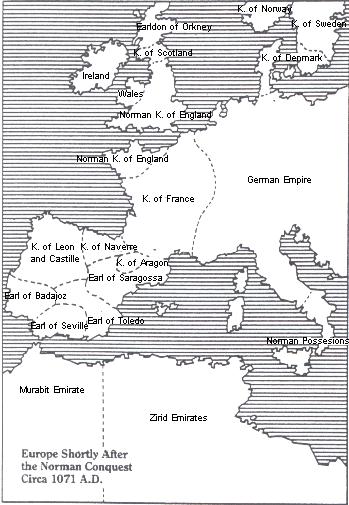
The battle of Hastings is familiar to every English school child -- and to a fair number of Canadian and American schoolchildren as well. There, on 14th October, Harold died of a Norman arrow, along with two of his brothers. The English troops nevertheless did not surrender immediately, but they had lost their chief leader and strategist. On Christmas day 1066, William of Normandy became William I of England. And that has made all the difference.
|
William introduced into England a new nobility, new customs at court, and a new language. By 1076 not one of the twelve earls were English. By 1086 only two English men of any landed-status survived. The language of government, much of which had been Anglo-Saxon since Alfred's day, became Latin and the language of the court became French. For several generations after the Conquest the highest offices in the land were always held by Normans or others of non-English blood. The "Normanization" even reached into the church: the bishops first, then gradually the abbots. By 1087 only three of thirteen abbots were English. For those English who would do business with the French court, schools were established and tutors hired. (Chaucer gently mocks the French speaking learned by young ladies at the Benedictine convent of St. Leonard's at Stratford le Bow.) For two hundred years after the Conquest, French remained the language of the upper classes. In addition to Normans, William recruited men from Flanders, the low Countries and Bretons to settle in England. English culture was submerged. |
The castles of heavily outnumbered conquerers dominated the surrounding area. The Normans brought vigourous powers of organisation and a willingness for change, but also a readiness to adapt. They introduced superior military tactics, elements of French law including the idea of trial by jurys, and even Christianity.
William I may not have been interested in learning the language of his new kingdon, but he was certainly interested in learning about its people. In 1085 he instituted a nationwide census called the "Domeday Boke". Among the items recorded were the names and land-holdings of every county and shire. It is the most important source of English history. And it was the beginning of accurate and systematic record keeping in this country. All ancient English titles and deeds begin here, as well as many, many family names.
The Middle Ages
The migration from the continent into England after 1066 was different in character from the migration of Angles, Saxons and Danes in previous centuries. The number of settlers was small compared with earlier migrations, and they were mostly men of high social rank, who established lordship over the English inhabitants of their newly-acquired lands. However, not all of these settlers were from Normandy. Those who came over with the Conqueror included men from Flanders, men from Brittany, and adventurers from other parts of France attracted by the prospect of land in England. By the end of the reign of William the Conqueror (1087) these incomers had established themselves over most of the southern three quarters of England. The extreme north of England was as yet only lightly settled by Normans, but during the reign of Henry I (1100-1135) a second wave of Norman immigration took place. A number of these men received land in the northern counties.
Thus by the early 12th century a ruling class of continental origin had established itself thoughout England. But the tide of Norman expansion did not stop at the borders of the English kingdon. As early as c.1070, William fitz Osbern (Earl of Hereford) had built a castle at Chepstow (Gwent) from which he dominated the south-eastern corner of Wales. He was the first Norman to penetrate Wales. Following his example, many other Norman adventurers moved into Wales over the next century. They displaced the native Welsh rulers and established an intricate pattern of semi-independent lordships in which Normans ruled over a predominantly Welsh population. At the same time, some English families of Norman origin moved north into Scotland, with the encouragement of the Scottish kings of the 12th Century, notably David I (1125-1153). Scotland's Norman settlement was accomplished by peaceful immigration rather than by military conquest. Finally, in the second half of the 12th Century, Norman lords reached Ireland. Under the leadership of Richard fitz Gilbert (better known as Strongbow) whose family had established itself in Wales around the end of the 11th Century, the Normans established themselves in Leinster (south-east Ireland). By 1180, John de Courcy, a Norman lord from Somerset, had completed the conquest of much of Ulster. But the quest for Norman expansion was now beginning to lose much of its momentum. The Norman conquest of Ireland was never complete. Much upland territory, together with large parts of the north west of the country, remained under native Irish control, though nominally subject to the overlordship of the English king.
Although the Norman settlement in the British Isles was never large in numerical terms, its influence on personal names was far-reaching. Norman personal names soon became fashionable at all levels of society, replacing many of the previously popular Anglo-Saxon or Anglo-Danish names. By the end of the 12th Century names such as Robert, Henry, William, Richard and Roger had become widespread amongst English as well as Norman families. The transition from Anglo-Saxon or Anglo-Scandinavian to Norman personal names is well illustarted by the familiy of the lords of Brancepeth in County Durham. They were of native origin but assimilatd themselves to Norman ways in the 12th Century. By the end of the century they had ceased using such names as Maldred, Dolfin and Uchtred and had adopted the Norman names of Robert and Geoffrey. Such was the influence of fashion, so powerful was the desire to emulate social superiors, that many of these pre-conquest personal names had almost entirely dropped out of use by c.1200.
The Norman impact on place names, however, was less substantial. The Normans did not found new settlements , but rather established lordship over those that already existed. They rarely changed the names of the villages they ruled. Sometimes they added their family name to the existing village name to identify their lordship more precisely: one example is Stratfield Mortimer in Berkshire. This lordship was held by Ralph de Mortimer, one of the followers of William the Conqueror. Sometimes they gave French names to natural features, such as many places named Beaumont, beautiful mountain. Another example is the village north of Durham City known as Pity Me, which was names Petite Mer, little lake, by the Norman lords of Durham.
In 1154, when Henry II ascended to the throne, the links between England and the continent which William the Conqueror had established became even more wide-ranging. Henry was already Duke of Normandy and Count of Anjou. Through his wife, Eleanor, he also ruled Aquitaine, the great Duchy which extended over much of south western France. These continental lands continued to be administered by their own local officials: few if any Englishmen migrated to their king's dominions in France. In fact, the movement was the other way. Ambitious men from the continent territories, and even further afield, came to serve the king in his English court. Sometimes they even rose to positions of influence and authority in the English administration. Such men were often the objects of hostility in England.
For instance, in Magna Carta the barons required King John to "dismiss completely" a group of Angevin administrators who held office in England. Even after the loss of Normandy and Anjou in John's reign, men from France continued to play a part in English politics and administartion. In the reign of John's son, Henry III (1216-1272), Poitevin servants and officials at court incurred much unpopularity. While in Edward II's reign (1307-1327) the Gascon knight , Piers Gaveston, became the king's favourite and the centre of the political storms that raged in England between 1307 and 1312. On the other hand an incomer, Simon de Monfort, whose family originated in France, enjoyed some support and popularity in England as the leader of a reform movement in the reign of Henry III. He has always been associated in the popular mind with the establishment of parliament.
These foreigners were of considerable political and adminitrative importance. Although they were few in number, they rarely established families which endured in England. Perhaps more significant in the longer term was the migration of Flemings into the British Isles from the over-populated country of Flanders and its neighbouring provinces. The cloth industry had been established in Flanders in early times, and many of the immigrant Flemings came to work in the wool and cloth trades in England. They have left their mark in places named throughout the British Isles: Flemingate, the street of the Flemings, in Beverly (Yorkshire); Flemingston in Pembrokeshire; Flimby (formerly Flemingby) in Cumberland, and Flemington near Glasgow. The personal name Fleming needs no interpretation, and is found in medieval Ireland as well as in England and Wales.
Migration from the contiment into the British Isles continued well into the 13th Century. As the population of England increased to the point where it numbered perhaps six million by 1300, so Englishmen too migrated, both within England and into Wales and Ireland. The stimulus for much of this migration was pressure on available resources of land. From the countryside landless men and woman made their way to the growing towns, much as impoverished Irishmen in the 19th Century migrated to Liverpool, Glasgow, London and New York. New settlements were established in the English countryside on land that had previously been uncultivated. Land was taken in from the abundant forest that still covered many parts of England. Land was also reclaimed from the sea and from marshland. Such expansion left little mark on personal names, for it was mainly the work of families long settled in England. However, it gave renewed life to some place names, notably Newton, Newtown, and Newbiggin (new buildings). The village of Newton-on-the-Moor in Northumberland, for example, was a settlement newly established on the edge of the village of Shilbottle. Its name gives an obvious clue about its origin and its location of previously uncultivated land.
English settlers also moved into lowland parts of Wales, where land was suitable for arable farming, and into parts of eastern, southern and midland Ireland. In both Wales and Ireland these English settlers have left their mark in personal and place names. In Ireland, English personal names are found alongside Irish names. Settlers gave their names to their villages, such as staffordstown (County Meath). They also gave English names to their strongpoints, such as the several Newcastles in Ireland. In Wales, English place names occur in the Vale of Glamorgan and particularly in southern Pembrokeshire. This area was extensively settled by Englishmen and Flemings, and well deserves its popular description as "little England beyond Wales". Towards the end of the 13th Century, the conquest of North Wales by Edward I was accompanied by the establishment of walled towns. These towns were intended to be bastions of English rule, and Englishmen were encouraged to settle there. The personal names that are recorded amongst the inhabitants of Caernarvon, Conway, Beaumaris, Denbigh and other towns thus have a distinctively English character.
Decay and Renewal
The expansion of population which had stimulated migration within the British Isles was halted and reversed by the famines and plagues of the 14th Century. The Black Death ravaged most of the British Isles in 1348-49. This was followed by two future outbreaks of plague, one in 1360-61 and the other in 1369. The cumulative impact of successive outbreaks of plague in the second half of the 14th Century reduced the population of the British Isles to scarcely more than half its size in 1300. This contraction was accompanied by a reversal of the migrations of the 13th Century. Many settlements on poor and unproductive land were abandoned. Some English settlers returned from Ireland as the native Irish chieftans re-established their hold over much of the country. In Wales the rebellion of Owen Glendower posed a particular threat to the predominantly English towns.
The traditional picture of late medieval Britain in decay and decline, and obsessed with death, sometimes can be exaggerated. There were also important signs of vigour and new life. In the early 15th Century Henry V conquerer Normandy -- in a sense of reversal of 1066 -- and to safeguard his conquest he encouraged Englishmen to settle in Normandy. Just as Edward I had created English towns in North Wales to act as bases of English power on his newly conquered principality, Henry V sought to attract English migrants to Harfleur, Honfleur, Caen and other towns. He also sought to plant Englishmen in the Norman countryside, so that they would have a vested interest in defending their lands against French attempts at reconquest. But the English conquest of Normandy proved short-lived. It lasted little more than thirty years. When the French reconquered the duchy in 1450 many English settlers returned home as penniless refugees. Some married French woman and remained, but they became an insignificant element in the Norman population. Whether the English occupation of Normandy had any impact on the place names or personal names of the duchy is uncertain, but it seems unlikely in view of the small scale and short duration of the occupation.
Within England in the later middle ages, the manufacture of cloth replaced the export of wool as England's principal commercial activity. Men and woman migrated to the flourishing cloth making towns of East Anglia, the Cotswolds, and the West Riding of Yorkshire. Some of the surnames associated with cloth manufacture, such as Weaver, Fuller, Tucker and Clothier, probably became more widespread during this period. On the Anglo-Scottish border groups of peasant soldiers linked by the possession of a common surname (such as Charlton, Bell, Dodd, Storey, Armstrong or Nixon) were encouraged by the rulers of both England and Scotland to remain on the border to play their defense against raiders from the opposite side of the border. These "riding surnames", as they were known, became notorious for disorder and criminality. However, they were also a valuable military resource for the crown. Whether all who bore a particular surname (such as Charlton) were really related to one another and could show descent from one family is doubtful. The headman of the surname group could offer valuable protection to all who bore his surname. There was great temptation for men who needed protection to assume the surname, even if they were not related by blood. The riding surnames reached the height of their notoriety, and their importance, in the mid-sixteenth century as the Anglo-Scottish war flared up again. The pacification of the borders after the union of the English and Scottish crowns in 1603 brought an end to their martial way of life, leaving as its memorial the splendid ballad literature which enshrines their exploits.
By the early 16th Century, the population of Britain was once again beginning to increase in size as the incidence of plague declined. Once again English influence began to extend itself over other parts of the British Isles. The attempt to force a closer relationship with Scotland in the 1540's ended in failure. However, both Wales and Ireland felt the impact of renascent English power. By acts of parliament in 1536 and 1542 Wales was united with England. The Norman lordships were abolished and replaced by counties on the English pattern. For Welshmen, the Acts of Union, the Reformation, and the extension of anglicised education in Wales open up wider horizons. There were many opportunities, particularly for lawyers, to play a part in government and administration in England as well as in their own country. In Ireland, political problems that the English faced were much more intractable. These problems compounded after the Reformation by religious differences. The policy of the Tudors (particularly Elizabeth I, and James I) after 1603 was to re-establish and maintain English authority over the whole country. One of the methods they adopted to reinvigorate the English presence there was the plantation of English settlers. The idea of encouraging English settlers to migrate to Ireland so as to shore up the English lordship there had been put forward as early as 1399 by Richard II. He had suggested that a man and a woman from each parish in England should move to Ireland and live on the borders of the English lordship there. The scheme came to nothing, and Richard II lost his throne soon after. At a time when land was an abundant resource in England there was little incentive to migrate to an uncertain future in an unknown country. In the sixteenth and seventeenth centuries, the idea of plantation was taken up much more vigourously; firstly by Mary Tudor, then by Elizabeth I, and most significantly by James I. The Irish counties known until 1922 as King's County and Queen's County (now Offaly and Laoighis) were planted with English settlers in the reign of Mary Tudor. Her husband, Philip II of Spain, was titular king of England. The chief towns of the two counties were named Philipstown and Maryborough (now Daingean and Portlaoise.) In Elizabeth's reign a plantation was planed in Munster , but neither this nor the plantation in King's and Queen's Counties achieved the hoped-for success in underpinning English rule and the Protestant Reformation. The most significant plantation, from the point of view of subsequent history of Ireland, was the Ulster plantation initiated in 1609 by James I. Both Scotsmen and Englishmen were encouraged to settle in Ulster. The Scots settlers were particularly numerous in north Down and south Antrim (the area around Belfast). At the same time the London Companies leased land north of County Derry and gave the prefix London to the city and county.
The plantation in Ireland coincided with the first English settlements in North America. Some of those who served in the campaigns in Ireland and planned the plantations there, also took part in the first English attempts at establishing colonies on the mainland on North America. In cultural terms the native Irish seemed in some respects to resemble the aboriginal inhabitants of North America. The language and customs of both peoples appeared equally strange to the colonising Englishmen. The experience which 16th Century Englishmen gained in Ireland was an important preparation for the much more extensive colonising activities in America which were to follow in the 17th Century.
Emigration to the New World
Destinations
The records of emigration from Great Britain enjoy one incomparable advantage over those of immigration into the island: The immigrations were, in major part, prehistoric, and therefore subject to interpretation and enormous gaps in reliable information; the emigration has nearly all occurred in historical time and has been, in spite of the usual human susceptibilities to bias and error, recorded with remarkable objectivity.
Not until 1604, in the reign of James I would there be any further significant movements affecting the island population. These would entail some immigration from the Continent, but substantial emigration. There was emigration to almost all the rest of the world, but most especially to the American Colonies, to Canada, and to Australia. The purpose of this section is to help you understand why so many English subjects emigrated, and when, by reminding you of the historic factors which occasioned those migrations. This knowledge may help you in determining where some of your family emigrants went, and may help you if you should undertake to trace any of them.
At first thought, emigration seems a comparatively simple concept -- a person or family leaves home and country for somewhere else. But just a little more thought begins to reveal complexity of the subject. First, there are different classes of emigration. Broadly, there are two: voluntary and forced. Forced emigration from England has occurred historically for several reasons. The one that has garnered most attention in the history books is religious persecution. The history of England from Henry VIII to William and Mary is a record of religious persecutions: Protestants by Catholics, Catholics by Protestants, and at times Protestants by Protestants. In each successive change of rule, both well-born and commoners were caught on the wrong side of the issue.
Emigration to America
Of the two earliest groups of emigrants who looked for better futures in the New World, the first were primarily adventurers looking for a short-cut to the East, or quick profits such as had fallen to the Spanish.
The second and slightly later group, beginning in about 1620, were interested first of all in religious freedom -- at least for themselves. These people were more readily successful in their quest,perhaps because the riches they sought were more personal, more spiritual. What they sought in the new land was religious freedom. What they wanted to leave behind were the intolerance of there society, the vagaries of royal decrees, and the general turmoil that was brewing in England.
This turmoil seethed below the surface but did not reach full boil under James I. It was clear that the Scots king was determinedly anti-puritan; it was at times not clear even to non-puritans whether he might revert to the Roman faith of his mother Mary, Queen of Scots. All protestants wondered that he seemed to condone the suit of his son Charles for the Infanta of Catholic Spain.
The first attempt at establishing a foothold in the New World was launched by Sir Walter Raleigh while he was still in the good graces of Elizabeth I. Excited by reports brought home in 1584 by his navigators Philip Amadas and Arthur Barlowe, he commissioned an expedition the following year under command of Sir Richard Granville and Sir Ralph Lane. The expedition attempted a settlement on Roanoke Island close by the northeast coast of what later became North Carolina. The effort failed for several reasons, but especially for lack of sufficient supplies and a sound core of experienced labourers.
A second attempt launched by Raleigh in 1587 seemed at first more promising. But it ultimately contributed to one of the unsolved mysteries of history. After landing and getting the settlement under way, its commander, John White, returned to England for more settlers and supplies. Especially needed were food staples like wheat and flour which the colonists had been unable to coax out of the new soil with their limited knowledge of farming. But when White returned to Roanoke early in 1591, the colonists had vanished without a trace except for the word Croatoan carved into the trunk of a tree. Was it merely a misspelling of the name Roanoke? Or was it the name of another island or a village on the mainland? The answer has never been discovered. In 1937 through 1945 a series of stone tablets were apparently unearthed in the area. The tablets purportedly told of disease, hardship, desertions, and Indian attacks. But the authenticity of the tablets remains in dispute. And the mystery remains unsolved.
Captain John Smith had better luck with his next adventure at Jamestown, just off the Chesapeake Bay, a few miles up the river that he named for his King in 1604. If luck is usually on the side of those who are most determined, Smith earned his good fortune. So strong were his leadership skills that after some thirteen weeks in irons placed on him by jealous factious co-founders, he was released to pull the disputatious colonists together. Smith quickly established order at all levels, both by his commanding presence and his personal example. Later he was to write in his "True Relations...of Virginia" (1608) of the difficulties in getting cooperation from a group of "poor gentlemen, tradesmen, servingmen, libertines, and such like" who were "ten times more fit to spoil a commonwealth than either to begin or maintain one".
Smith persisted. Returning to England, he wrote and spoke at every chance of the great opportunities that existed across the sea. Nevertheless, some of the people who returned with him the following year he described as "felons and vagabonds" (read, "poor, lower class") who brought "such evil character on the place" that it was nearly impossible to recruit "decent" people. The best workmen in the Colony, he noted, were the few Dutchmen and Poles there. Writing to his impatient and meager company manager, he urged them to send fewer gentlemen and more "Carpenters, husbandmen, gardiners, fishermen, blacksmiths, masons" and others, along with tools.
And Jamestown survived -- just. After an injury forced Smith to retire to England, affairs in the colony again deteriorated into contentious factions within, and ever-more-alienated and hostile Indians without. When Lord Delaware arrived with fresh recuits and supplies in 1610 he found only 60 persons of the 490 Smith had left. And those sixty were in the very act of leaving the colony to sail north toward Newfoundland in hope of finding English fishing vessels which would rescue them from starvation and Indians.
In spite of adversity, however, Smith had founded well. The little colony doggedly held on and began to grow. By 1612, the plantations along the James River appeared to have crossed the line between failure and success.
Much of that success came from the discovery of a new crop and its introduction and exploitation in England and Europe: smoking tobacco. With seeds bartered and methods learned from the Indians, the settlers soon had the broad-leafed aromatic growing virtually everywhere -- even in the streets of Jamestown. By 1620, it had become the staple and current coin of the colony. At last the colony began to repay its investors.
At this time another English colony got under way to the north. In 1620, a small band of religious dissenters stepped ashore from the Mayflower and proclaimed the "New Plymouth" colony. This was no commercial venture. Whatever fortune these people would find in the new land, none had any intention of returning to the land of their birth. To the observant, the clouds of religious and civil war had already begun to gather on the English horizon. Although James I was by 1604 firmly in the Protestant camp -- the Hampton Court Council of that year had authorised a new translation of the Holy Bible -- his son Charles was another matter. Charles had already signaled his Roman Catholic inclinations by seeking a Continental Catholic to be his wife -- first in Spain, later in France. The publication in 1611 of the "Authorised Version" did little to allay the anxieties of many English Protestants.
Events following Charles's accession in 1625 led quickly to more unrest and more emigration. His marriage to Henrietta Maria, sister of Louis XVIII, further aroused the uneasiness of his Protestant subjects. But his autocratic and capricious behaviour over the next fourteen years would alienate all but a small number of devout loyalists. His quarrels with Parliament over taxation and civil rights would eventually lead to his murder in 1649. At this, and faced with the prospect of Puritan rule (Puritans could claim their fair share of intolerance), many royalists and nobles fled to America.
But all was not quiet there, especially as a result of Charles's attempt to wring money out of the colonies that he could not get out of parliament. More than he could possibly imagined, he was cultivating the seeds of independence. Royalists, though most Virginians thought they were, they were intractable when they saw their prized liberties threatened from any quarter.
As the dispute between Charles and Parliament heated up in England, Virginians rescinded the warm welcome they had earlier extended to Puritan tradesmen and other settlers. Soon Puritan ministers were forbidden to preach in the colony and Nonconformists were banished outright. But the Virginians, forced grudgingly to recognise the Protectorate, nevertheless offered a secure haven to fleeing royalists. And Cromwell did not halt the traffic in the transportation of "undesirables". He sent loyalist soldiers to the colonies as well as those he chose not to execute for their resistence to his regime.
By 1680, the European population of North America had grown to more than 152,000 inhabitants. There developed inevitably a recognisable, but fluid, class system: At the top a small ambitious group of landowners; a main body of yeoman who, once black slavery relieved them of hard labour, became the middle class; and at the bottom, the indentured servants. There were hard times, severe winters, food shortages and many disappointments in America, but success stories were also bountiful.
These tales travelled back to Europe and prompted thousands to leave their familiar homeland to begin a new life in a world where they often could not speak the language. Political, economic and social conditions drove many poor Europeans from their homes in tidal wave figures from 1840 on because they heard that the Americans had a successful revolution where the "old society" was overthrown. America became known as the place for every man to "strike it rich", and many did just that!
The word quickly spread beyond northern countries to the farmers of southern and central Europe. Prior to 1890, most immigrants came from Scandinavia, Germany, Ireland and England. In the following 30 years the mass of immigrants came from Italy, Austria-Hungary, Russia and again, Ireland. During the first two decades of the twentieth century, an astronomical 14.5 million immigrants arrived. They were mostly the persecuted and the poor, or as described by the inscription on the Statue of Liberty -- the "huddled masses yearning to breathe free".
Only one immigrant group came unwillingly to the New World. Black people who fell into the hands of unscrupulous kidnappers or who were sold by their enemies into slavery had initial hopes of escaping and returning home. However their hopes were dashed after arriving on the shores of the New World when families were split up and were sold to masters.
Most of the slaves came from the forested coastal belt of Africa. The Fanti, Ashanti and Akim tribes were from the Gold Coast. The Ibos (also spelled Eboes) came from the delta of the Niger River. The Mahis, Popos and Fidas were from Dahomey. Even though whole families were split up, the slaves were given English names so that they would be unable to make connections with other family members. Many slaves took the name of their master. Although the slaves were never given African names when sold there, records from slave ship captains and from slave auctions usually included the names of the African tribes represented.
Jewish people sought America's shores especially during the period from the late 19th to the early 20th Century. As late as 1880, there were only a quarter of a million Jews in the United States. By 1924, there were 4.5 million. They came for basically one reason: religious freedom. In some cities of Europe, Jews were permitted to practice their religion in compounds, but as history for fifteen hundred years testifies, they were scorned and persecuted by the populace. In America, they could also worship openly whether it be Orthodox, Reform, Conservative or even radical Reconstructionist.
Looking back on the thousands of lost legions who flowed into the U.S. borders, it is impossible to "glamourise" this period of American history. In reality, many exchanged a rural slum overseas for an urban slum there. The barriers to hurdle were high and difficult. But, paupers became store owners, the sons and daughters of illiterate farmers became schoolteachers and doctors. Others simply found exactly what they had dreamt of -- a tidy, happy life.
The post-World War II immigrants shed their homeland quicker than any others. These were men and woman "without a country" who couldn't safely return to their Iron Curtain homeland. Many of these people applied for citizenship papers the very day they landed in America. There is no particular ethnic group among these displaced people; they lived singly and became Americans overnight, their quest for freedom over.
Emigration to Canada
Emigration and its role in the making of Canadian history is an exciting account of people representing many backgrounds and beliefs, who united over a span of centuries to carve out a new nation from an uncharted wilderness. Fortitude, heroism, and discernment were the hallmarks of these transworld emigrants, whose self-renewing vitality created one of the grandest national epics in the history of the western world: The birth and the coming of age of Canada.
Just as England was being invaded for the lst time by William the Conqueror in 1066, the amazing story of Canada was about to begin with the exploration of its eastern coast by other Viking warriors. Those Norsemen established the first Canadian settlement at L'Anse aux Meadows, in northern Newfoundland. Shortly thereafter, however, this Viking outpost was abandoned; and no known visitors would appear on Canadian shores until almost 500 years later.
Yet once Canadian exploration resumed, it would continue virtually unabated until the present day. This resumption began in earnest when the English explorer, John Cabot, landed in 1497 either on the coast of Newfoundland or Cape Breton Island. Cabot, who had been commissioned by Henry VII of England to discover new trade routes to China and India, claimed all of Canada for his King.
Thirty-seven year later, the French explorer, Jacques Cartier, sailed into the Gulf of Saint Lawrence, landing eventually on the Gaspe shore of what is now Quebec. In doing, he claimed the vast new land for his King, Francis I.
Following Cartier, at the beginning of the next century, was Samuel de Champlain, sometimes called the Father of New France. Together with Sieur de Monts, Champlain founded Quebec, the first permanent settlement in Canada. Shortly thereafter, his followers established a missionary centre within Quebec named Ville Marie. In 1642 its name was changed to Montreal.
Two years after he assumed personal rule of France, the most glorious of all French kings, Louis XIV, made Canada a province of his kingdom. This was done in 1663; and one hundred years later, there would be about 60,000 French settlers in the new province.
Because England and France were mortal enemies during and long after the reign of Louis XIV, the Anglo-French wars on the European continent that resulted from this hostile relationship all had counterparts in the Northern American continent. Thus English and American colonists did battle with French Canadians during the War of the League of Augsburg (1689-97), Queen Anne's War (1701-13), King George's War (1740-48), and the French and Indian War (1754-63).
In virtually all of these conflicts, the Mother Country left English and American colonists to their own devices, and at times this cost dearly in human suffering and loss of life. Moreover, territories captured by the English and American colonists in Canada were usually returned to the French through the peace treaty that ended King George's War.
Fortunately, Great Britain took its participation in the French and Indian War more seriously -- and none too soon. During the first four years of this conflict, the French, led by the Marquis de Montcalm, inflicted punishing defeats on Anglo-Americans. Not until 1758 did the latter successfully counterattack and, in so doing, overrun French fortresses on the Canadian-American frontier.
Leading the Anglo-American forces in what proved to be the final showdown was General James Wolfe, who attacked Montcalm and the French armies on the Plains of Abraham. In emerging victorious in this contest, which became known as the Battle of Quebec, Wolfe, (along with Montcalm), lost his life. In dying, however, the great British general made it possible for generations of others to live and prosper in Canada that would never have to face the prospect of another serious invasion attempt.
In the immediate aftermath of General Wolfe's liberation of Canada, this brave new world experienced its first major, multi-cultural infusion. From 1763 to 1774, it has been carefully estimated that approximately 45,000 pioneers set sail from the five Irish ports of Londonderry, Belfast, Newry, Larne, and Portrush for the Atlantic coast of Canada. These determined sea voyagers were joined by even larger numbers of emigrants who came mainly from Scottish areas of Islay, Skye, Inverness, Lochiel, and the Hebrides, and from of course, England herself.
In 1783, 40,000 American colonists affirmed there loyalty to the British Crown and left the United States for new and happier homes in Canada. Like their English, Scottish, and Irish brethren, these "United Empire Loyalists" were confirmed British patriots who rose to the challenge of building new cities on the very cutting edge of civilisation.
Rather than crushing the totally vanquished French who had inhabited Canada since 1534, British American governors instead implemented the Quebec Act of 1774. This benevolent law, termed the "Magna Carta of the French Canadian Race", placed French civil law, the French language and the French Catholic Church under the protection of the British crown. Thus the political rights and the freedom to worship as Roman Catholics were solidly guaranteed for the French population of Canada.
The clairvoyant and merciful Quebec Act also assured the loyalty of French Canadians to Great Britain. In 1775 when the American rebels mounted a pathetic attempt to conquer Canada, the "Habitants", as they were called, joined the British Canadians in totally repulsing all armies of the would-be invasion.
In 1791 Great Britain increased the local freedoms of both the British Canadians and the "Habitants" by creating two provinces in the Saint Lawrence and Great Lakes region -- a lower Canada to remain French and an Upper Canada to be English. Both provinces received the same liberal government as that enjoyed by the thirteen colonies before the American revolution.
Such an arrangement worked well for many years, and in 1812 it was put to the test. At this time, the young and brash United States declared war on Great Britain, and, in so doing, decided once again to "conquer Canada".
Just as in 1775, however, American belligerence aroused a national sentiment anong both the British and French Canadians. Reaffirming their loyalty to the British Crown, Anglo-Saxons and Anglo-Celts joined forces with the "Habitants" to drive American foreigners out of Canada.
Even the Act of 1791 could not guarantee domestic tranquility for all Canadians indefinitely. By the 1830s it became clear that more self-government was needed by the British and French populations of Canada.
In 1839, one of the classic documents in the rise of the British Commonwealth of Nations, the Durham Report, recommended numerous liberal reforms in the administration of Canada. In political matters, it made a strong case for Canadian self-government in which an elected assembly would assume virtual control over all domestic affairs.
Most of Durham's Report was accepted immediately and a united Canada was given the machinery of independence in 1840. And, when yet another military effort to annex Canada into the United States was launched in 1866, the Canadians proved more than capable of repelling the armed "crackpots".
Meanwhile, in the face of the American Civil War, a federal constitution -- drafted in Canada by Canadians -- was approved by the British Government in 1867 as the British North American Act. By this action the maritime Provinces (Nova Scotia and New Brunswick), Upper Canada (Ontario), and Lower Canada (Quebec) became a federal union, governed by a common parliament, in which the majority party controlled a responsible ministry according to British principles of cabinet government.
By 1905, this federal union, constitutionally designated the Dominion of Canada, would acquire the additional provinces of Prince Edward Island, Manitoba, British Columbia, Alberta, and Saskatchewan. Linking all the provinces was the Canadian Pacific Railway.
The Dominion of Canada, though never large in population, possessed from the beginning a significance far beyond the mere numbers of its peoples. It constituted the first successful example of the granting of political liberty within one of the European colonial empires, and thereby provided the blueprints for the self-government of Australia, New Zealand, South Africa, India, Pakistan, Sri Lanka, and the former British colonies in Africa.
During World War I and World War II, Canadians of all backgrounds and cultures fought bravely on behalf of the cause of world democracy. Especially noteworthy were the decisive contributions made by Canadians to the common effort to crush Italian Fascism, conquer Nazi Germany, and liberate the Pacific from the Imperial Japanese menace.
Yet Canada has not been completely free from cultural fragmentation, underscored in turn by negative political and economic overtones. Described by Lord Durham as the "warring of two nations in the bosom of a single state", an Anglo-French dualism, excerbated at times by bombastic rhetoric of political hacks, has had some ugly manifestations, including murder, as late as the 1980s. One of the greatest challenges to the multi-cultural leadership of Canada is, and will be, to bridge this gap and to produce a new unity in the Canadian community.
Emigration to Australia
Australia was the last continent to be discovered and colonised by Europeans. Whether earlier contacts had been made by the Chinese, Malays or Arab traders remains an unsolved mystery. Certainly it was within the capabilities of their ships to penetrate so far south, but there is no documented evidence to support such theories. The land's original inhabitants, the Australian aborigines, may have been living there as long as fouty thousand years ago, but until about 1600 they remained quite unknown to Europeans.
A European presence in the Indian and Pacific Oceans developed from both the east and the west. As early as 1511, the Portuguese had established a trading station and fort at Malacca. From the other direction came the Spanish, with similar objectives. The Spanish were particularly interested in discovering the legendary "Terra Australis Incognita" -- The Great South Land.
Inca legends of wealth to be found across the Pacific stimulated the voyages of Mendana in 1567 and 1595, specifically seeking the Great South Land. On the first voyage, land fall was made in the Solomon Islands, so named in the faint hope that this was the site of King Solomon's gold mines. The second voyage resulted in the discovery of the Marquesas Islands.
Fernandez de Quiros, a pilot on the second Mendana expedition, obtained permission to make a new search. The missionary zeal of the promoters is reflected in the fact that his ships carried no less than six Franciscan friars. They arrived in the New Hebrides, which at first Quiros mistook for the Great South Land. It was here that the ship commanded by Luis Vaez de Torres became detached from the other two, and Torres decided to head for the Philippines. Driven more by the exigencies of tides, winds and reefs, he threaded his way through the strait between Australia and New Guinea early in September 1606. Torres was not to know that the Australian mainland had in fact been sighted -- and two hundred miles of it charted -- in the region of Torres Strait six months before.
Late in 1605, the "Duyfken", commanded by captain Willem Jansz, was sent on a voyage of reconnaissance towards New Guinea. During March of 1606, Jansz sighted Cape York and sailed south. By 1613, the Dutch ships were taking a faster route to the Indies by travelling due east across the Indian Ocean then northeast. In this way, many of their trading ships encountered the Western Australia coast -- quite a number were wrecked there.
The two voyages of Abel Tasman round off this period of Dutch exploration. On the first, Tasman really circumnavigated Australia. On the second voyage, two years later (1644), he charted the northwest of the continent, filling in the gaps, so that the entire western half of the coast, from Cape York around nearly to present-day Adelaide, was now known.
English contacts began with the wreck of the "Tryal" in Western Australia (1622). A second English ship reached the same coast in 1681, captained by John Daniels. Six years later, the "Cygnet" sailed from Timor to explore the region.
After 1700, there were many English voyages across the Pacific, but none approached Australia. In 1768, Captain James Cook was dispatched in the "Endeavour" to set up an astronomical observation post in Tahiti. He then sailed to New Zealand and charted both islands. While sailing west from New Zealand, Captain Cook and his crew sighted the Australian mainland on 20th April 1770 at Cape Everard near present Victoria/New South Wales border. On Sunday 29th April, the first landing was made in Botany Bay, a few miles south of Sydney. Over the next six weeks, Cook travelled north along the coast, mapping and occasionally putting ashore exploration parties. On 11th June, the ship struck coral in the Great Barrier Reef and was all but lost. For weeks it had to be beached near the site of Cooktown for repairs. Resuming his voyage, Cook sailed through Torres Strait. On 22nd August 1770, he and a small official party went ashore on a small island near Cape York, hoisted the British flag and solemnly took possesion of the whole eastern coast in the King's name. Today this island is known as Possession Island. Cook touched Australia once more on his third voyage, when he landed in Adventure Bay, Tasmania. This was in January 1777.
In the late 1770s, the question of overcrowded gaols in England became critical. This led to the debate over transporting criminals to penal colonies. Historians have long been divided as to the motives that lay behind dispatching the First Fleet and establishing a settlement in Australia. The usual accepted explanation has been that it was occasioned by the overcrowded state gaols, but other causes have been put forward. These include the motive of setting up one or more posts in the Pacific region, or that of Imperial strategy -- the wish to "show the flag" in that part of the world.
Not until mid-1786 was the decision finally taken to transport convicts to Botany Bay. Intention became reality on 18th August 1786, when Lord Sydney sent a letter to the Lords of the Treasury announcing that it was "The King's pleasure that ships should be provided for carrying 750 convicts to Botany Bay with such provisions, necessaries and implements for agriculture as may be necessary for use after their arrival". Fitting out the expedition and providing adequate supplies for the new settlement's first couple of years was an enormous task, and went on continuously from August 1786 to May 1787.
The fleet of eleven ships set sail just before dawn on 13th May 1787. By 20th May, the fleet lie about two hundred miles west of the Scilly Islands (the "toe" of England). Captain Arthur Phillip now turned towards the south, his goal the Canary Islands, where he intended to take on water and supplies of fresh food.
By the evening of 3rd June, all the ships were anchored in the harbour of Sana Cruz, in the Canary Islands. A week's sailing brought them to the vicinity of the Cape Verde Islands, a thousand miles from the Canaries and directly on their proposed route to Rio de Janeiro in Brazil. Ahead of them lay seven weeks of sailing before the fleet would again come to anchor. By the evening of 5th August, the ships were all moored in Rio harbour. The First Fleet remained in Rio for a month, during which much time was devoted to making necessary repairs to the rigging and sails of the various ships.
On 4th September, the fleet resumed it itinerary, bound for the Cape of Good Hope, a distance of nearly three and a half thousand miles. The crossing took five weeks and four days. Arriving on 14th October, the fleet would spend a month at Cape Town.
On the afternoon of 12th November, the First Fleet was again under sail, on what would prove to be the longest sector of the whole voyage. It was not until 20th January 1788 that the ships reached Botany Bay. On the 21st, Phillip set out with a party of reconnaissance in three small boats to investigate the possibilities of an inlet to the north which Cook had named Port Jackson. Port Jackson proved to be an ideal place for the new settlement.
In the evening of this first day, 26th January, the whole of the party that had come from Botany Bay in the "supply" assembled at the spot where they had landed and where a flag now flew from an improvised flagpole. The marines fired volleys, and toasts were drunk to the king and the Royal Family, and to the success of the new colony. This was the day that is now celebrated as Australia's Foundation Day.
The food situation continued to be the new colony's main problem for the first few years after 1788. The arrival of further consignments of convicts, especially the great number of sick and dying by the Second Fleet (June 1790), did little to improve the position. Only by 1792 could food be grown in any quantity, and additional supplies could sometimes be purchased from visiting ships, chiefly from America.
After 1821, transportation was stepped up. It would still run for another twenty years (at least to New South Wales), but it would be over those twenty years that the bulk of the 120,000 convicts who came to the colony would arrive.
The years 1825-29 saw the number of arrivals of small capitalist immigrants rise dramatically from about five hundred to two thousand, with a consequent rise in the demand for labour.
From the middle 1830s, the trickle of free immigrants became an absolute flood. Between about 1836 and 1841, thousands came to seek their fortune in Australia.
The founding of Port Phillip had in fact coincided with the beginning of a great period in Australian history -- the squatting era. From about 1835, sheepmen fanned out north, west and south from Sydney, taking their flocks hundreds of miles into the interior.
The pattern of national development changed dramatically when in 1851 gold was discovered in the colonies of New South Wales and Victoria. There was an enormous rise in the total population between 1851 and 1860 which rose from half a million to a million. The population of Victoria was multiplied seven-fold.
From 1860 to 1890, the history of Australia might be described as a period of constant, steady growth made possible by considerable injections of British capital.
The population grew steadily, if unremarkably, much of the increase being due to sustained immigration from the British Isles. By 1890, about three and a half million people lived in Australia but their orientation was very clearly towards Britain.
It was in 1898 that Australia became a federation. Although Australia had now become a seperate nation rather than a set of colonies in no way diminished loyalty to Britain, the monarchy and the Empire. This was especially evident in the theatre of war. Some Australian troops served in the Boer War, but the First World War showed the real extent to which they were prepared to suffer and die for the land of their forefathers. All who served in the armed services were volunteers, and the figures speak for themselves. Four hundred thousand volunteered and three-quarters of these saw overseas service. Out of these 330,000 two-thirds were casualties, including 60,000 killed.
At the outbreak of World War II, the Prime Minister's carefully chosen words expressed all: "Great Britain has declared war, and as a result, Australia is also at war". During this conflict, as during the First World War, Australian troops served in a number of overseas theatre areas, though with smaller losses.
In the aftermath of the war, determined efforts were made to create a "new Australia", especially through the development of manufactures and a plan for massive immigration that would at once build up the population and provide a labour force for the new industries.
Immigration was stepped up, notably among peoples of non-British nationality and displaced persons from the war period. The old pattern of almost 100% British immigrants was gone forever, and Australia began to accept great numbers of people from other European countries.
The new pattern began with numbers of immigrants from northern Europe, then developed into mass immigration from Mediterranean countries such as Italy, Greece and Yugoslavia, and later still, Turkey and Lebanon. It was largely through this policy of deliberately encouraged (and assisted) mass immigration that the population, risen from four million to six million between 1900 and 1940, has increased to today's figure of over fifteen million.
The pattern changed again in the 1970s. The White Australia Policy was no longer held up as a national ideal, and Australia began to accept increasing numbers of Asian peoples, especially after the end of the Vietnam war. Today, people of quite a multitude of nationalities live in Australia -- some born there of parents from overseas.
More than two hundred years after its foundation, Australia presents a picture that would have been inconceivable even as recently as forty years ago.
Australia has become home to peoples from a great range of overseas countries -- peoples who have had to make radical adjustments to their way of life, but who today are as much a part of Australia as those British descent, whose forefathers created the first settlement over two hundred years ago.
How names originated and what the Pink names means
|
How a surname originates What does it mean Spelling variations |
How names originated and what the Pink name means
"What's in a name? That which we call rose; by any other name would smell so sweet".
William ShakespeareHave you ever had the experience where your name was misspelt? Perhaps on a bill or in a letter. What are the typical misspellings or pronunciation errors associated with a surname. It strikes one very personally because your surname is your possession and identification, and it tells the world who you are. Historically, names have served as a fingerprint of life, perhaps a basic clue to one's personality. Knowledge of naming practices in our ancestral country of origin can help us trace our respective families back to a village or a place, tell us their occupation, or it can give us an idea about what our ancestors looked like. The intriguing story of surnames began in thousands of medieval villages and manors. How and where they began, what they originally meant, and their various spellings, is called the study of onomastics.
By the end of the 13th Century, Englishmen and English personal names were to be found not just in England but many parts of Scotland, Wales and Ireland as well. These personal names were derived from a variety of sources. Some were biblical in origin, or were the names of saints and martyrs of the early Christian church. Many were Norman, and a handful were Anglo-Saxon survivals or revivals. The Anglo-Saxon name Edward, for instance, enjoyed renewed popularity as a result of Henry III's cult of his saintly predecessor Edward the Confessor. Henry's son, grandson and great-grandson were all named Edward. Some names owed their currency to a specific event, such as the martyrdom of Thomas Becket Archbishop of Canterbury in 1170. Some saints who were popular in particular regions, such as Cuthbert in the north, might influence the choice of personal names in those regions.
But in these early centuries, the concept of a surname, a name which identified one's family and which was passed from father to son, was hardly developed at all. The addition of one's personal name or an additional name describing one's occupation, place of origin or residence, or kinship - e.g. John's son - or a characteristic such as Redhead, was common enough in the eleventh and twelfth centuries. Post-conquest England had a relatively small stock of widely used personal names, and some method of distinguishing between the numerous Johns, Williams or Thomases in a village was obviously necessary. The crucial point about surnames in the English-speaking world, however, is that they are hereditary in the male line. This overwhelmingly important feature of surnames appears to have become established in England sometime between the late 13th and early 15th centuries. Although we take the hereditary nature of our surnames for granted, and accept almost without question that we inherit them from our father's line, it is important to realise that this has not always been so in England, as is not so even today in some western countries (such as Iceland and Spain).
Why surnames became fixed and hereditary in England in the later middle ages is extremely difficult to understand and almost impossible to date with any precision. By the 1370s the word "surname" is found in documents, and has come to acquire some emotive and dynastic significance. Men sometimes sought to keep descendants of their own in the male line. Although we can see that the handing on of a surname has become a matter of pride, we can only guess at the reasons for adopting hereditary surnames in England in the first place. Government became more and more a matter of written record. As the activities of government, particularly in the levying of taxation and the exaction of military service, touched an ever-widening range of the population, perhaps it became necessary to identify individuals accurately. In some larger urban communities especially, personal names were no longer sufficient to distinguish people for social as well as administrative purposes. It the countryside, manorial administration, with its stress on hereditary succession to land, needed some means of keeping track of families and not just individuals. We can be certain that by about 1450 at the latest, most Englishmen of whatever social rank had a fixed, hereditary surname. This surname identified the family, provided a link with the family's past, and would preserve its identity in the future. It is not surprising that the preservation of surnames became a matter of family pride. It was a cause for much regret if a man had no male descendants to whom he could pass on the surname he himself had inherited and had borne with pride.
Most of the surnames that appeared in England in these centuries evolved from four general sources: A man's occupation; where he lived or had come from; his father's name; or from a personal characteristic or physical feature.